If you are an indie game developer, a computer science student building your first Unity or Unreal project, or an engineering studio shipping mobile titles in India, the headlines over the last two years have been genuinely frightening.
News bulletins constantly flash alerts about "Online Gaming Bans," "28% GST Crackdowns," "ED Raids on Gaming Portals," and "Ministry of Electronics and Information Technology (MeitY) Regulatory Notices."
Naturally, every creative programmer in Bengaluru, Pune, Hyderabad, and Delhi has the same anxious questions:
"Is game development still legal in India?"
"Do I need an expensive government permit or ministry license before uploading a casual puzzle or action game to Google Play or Steam?"
"Will the tax department slap me with a 28% penalty on my in-game ad revenue?"
"What happens if a school student plays my game—am I legally liable under India's new privacy laws?"
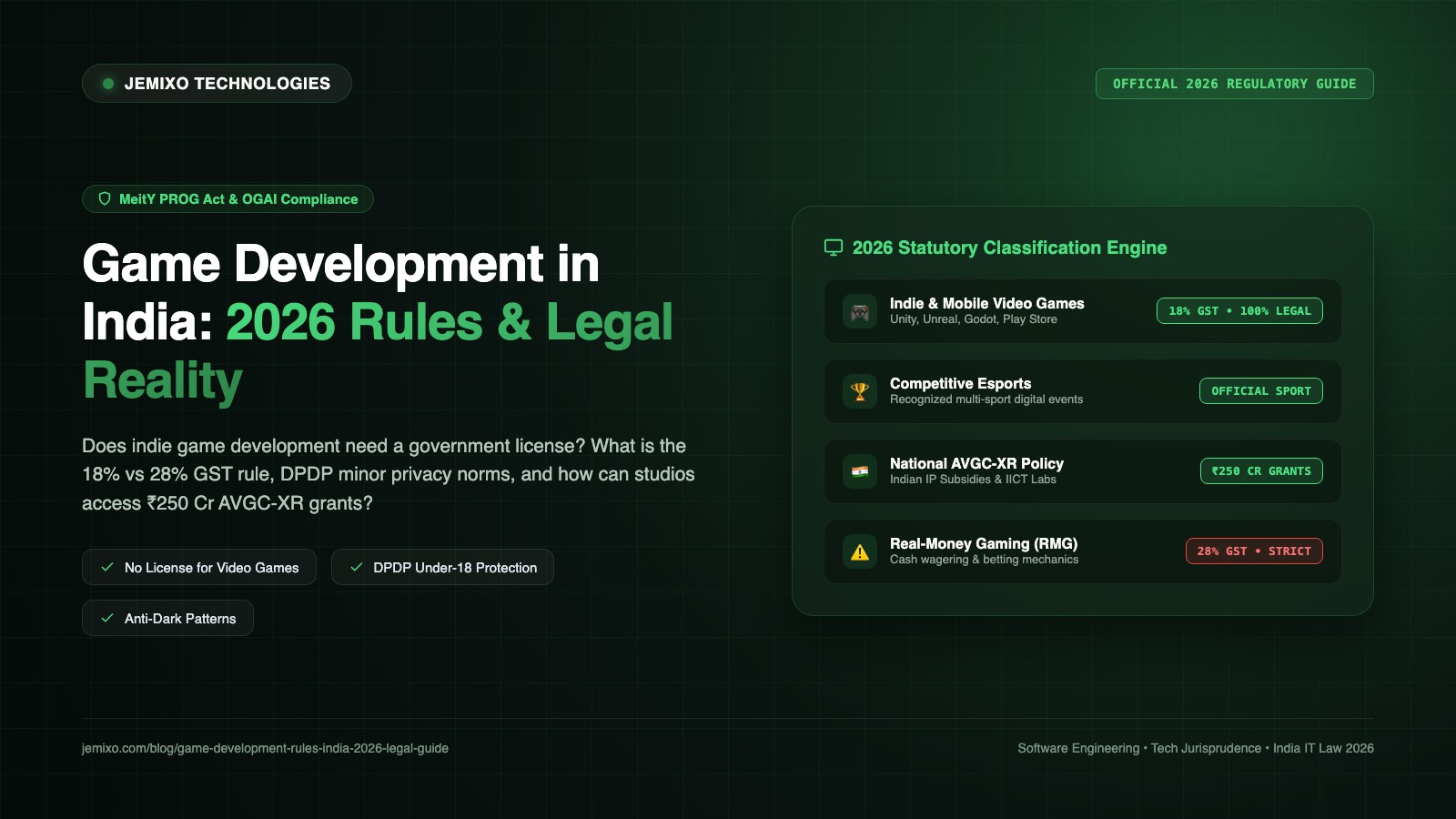
Let us put your anxiety to rest right away: Creative video game development is 100% legal, thriving, and actively subsidized by the Government of India in 2026.
However, the regulatory landscape has undergone its biggest legislative overhaul in Indian history. In May 2026, the Promotion and Regulation of Online Gaming (PROG) Rules, 2026 officially took effect under MeitY, establishing a centralized statutory authority—the Online Gaming Authority of India (OGAI).
Here is the definitive, no-nonsense legal, architectural, and monetization manual for anyone developing and publishing video games in India today.
1. The Core Distinction: Video Games vs Real-Money Wagering (RMG)
The single greatest source of panic among Indian developers has been the conflation of Video Games with Real-Money Gaming (RMG).
Historically, state police departments and local laws struggled to differentiate between a 3D story-driven platformer and a real-cash online rummy or poker app. In 2026, federal statutory guidelines have drawn an ironclad legal boundary:
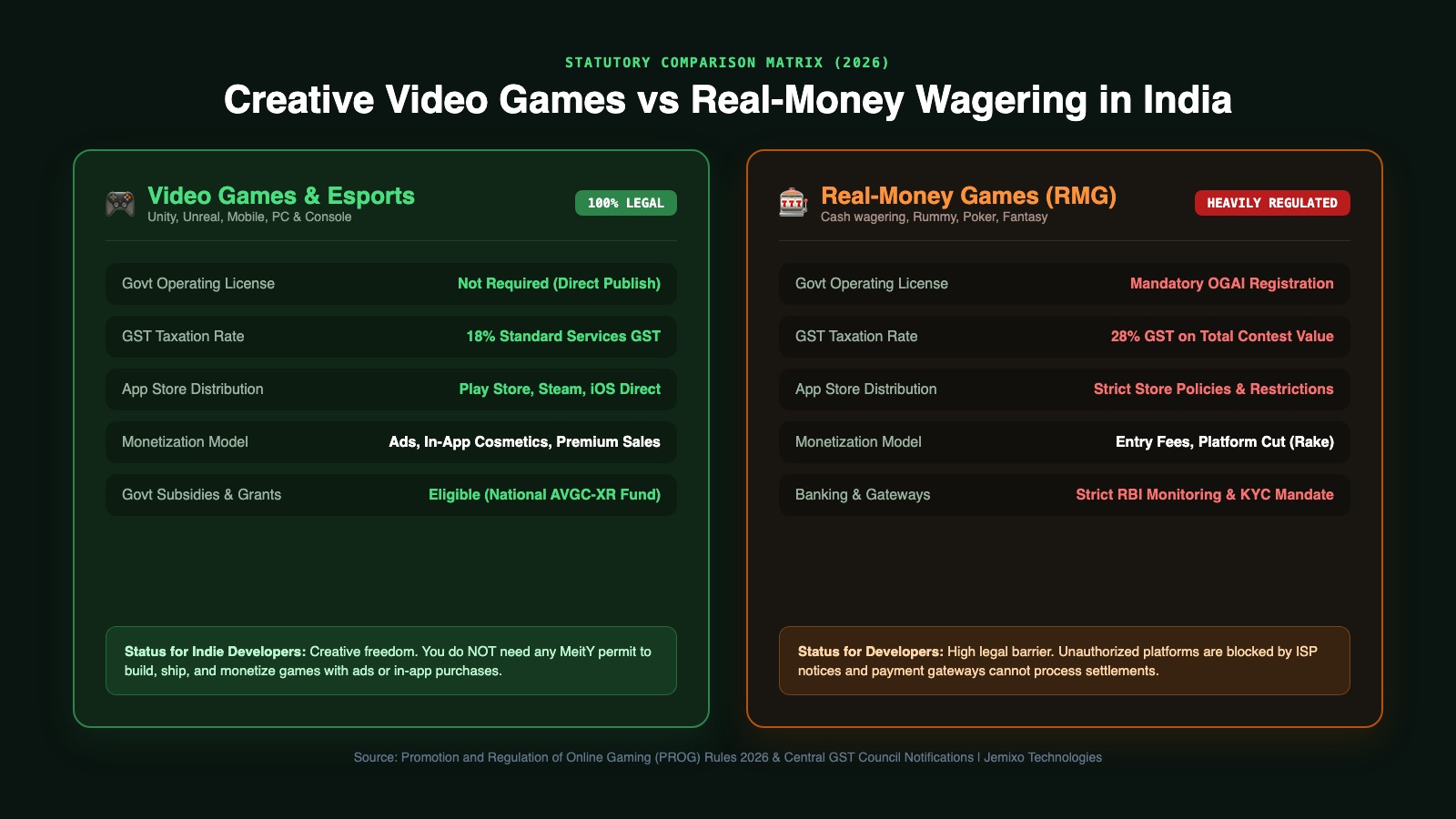
Category A: Creative Video Games & Esports (Safe Harbor)
- What it includes: Action games, RPGs, racing titles, platformers, casual puzzles, strategy titles, and competitive esports (e.g., titles like Raji: An Ancient Epic, BGMI, Candy Crush, or your custom indie Unity game).
- Core characteristic: The player pays for the game copy, cosmetics, season passes, or views ads. There is zero mechanism to wager cash or win real withdrawable currency.
- Statutory Status: Classified as digital artistic expression and creative software. No government operating license is required. You publish directly to Google Play, the Apple App Store, Steam, Epic Games Store, or itch.io.
- Taxation: Standard 18% GST on services and software (SAC 998434), identical to any SaaS or mobile utility app.
Category B: Real-Money Online Games (RMG / Wagering)
- What it includes: Platforms where users deposit INR to compete for cash jackpots, real-money fantasy sports, paid rummy, poker, and staking apps.
- Statutory Status: Heavily restricted. Under the 2026 PROG framework, any platform involving financial stakes must obtain mandatory statutory verification from the Online Gaming Authority of India (OGAI).
- Enforcement: Indian banks, UPI aggregators, and payment gateways are legally prohibited from processing transactions for uncertified real-money platforms.
- Taxation: Flat 28% GST applied to the full face value of contest entry fees.
[!NOTE] Key Takeaway for Indie Creators: As long as your game does not allow players to deposit rupees with the promise of withdrawing winnings, you are NOT an online money game. You are legally a software publisher.
2. Does an Indie Developer Need a Government License?
The short answer is NO.
You do not need a permit from MeitY, the Ministry of Information & Broadcasting (MIB), or local police to write game code, compile an APK or executable, and distribute it globally.
However, to legally distribute and monetize your game, you must operate within standard Indian corporate and consumer guidelines:
A. Business Entity Setup
- Hobbyists & Solo Creators: You can release free or ad-supported games on Google Play Console or Steam using a personal individual developer account.
- Commercial Studios: Once your game generates meaningful revenue (via in-app purchases or publisher advances exceeding ₹20 Lakhs annually), register a Private Limited Company or LLP to claim input tax credits and limit personal liability.
B. Banking & FEMA Compliance for Global Sales
When international gamers purchase your title on Steam (Valve) or the App Store (Apple), foreign currency (USD, EUR) is remitted to your Indian bank account.
- Ensure your bank issues an FIRC (Foreign Inward Remittance Certificate) or e-BRC (Electronic Bank Realisation Certificate).
- Export of software services outside India qualifies for Zero-Rated GST under a Letter of Undertaking (LUT), meaning you can legally export your game without paying 18% IGST upfront.
3. The DPDP Act 2023: Minor Protection & Children’s Privacy
This is the most critical regulatory compliance area where Indian game developers inadvertently expose themselves to legal liability in 2026.
Under India's Digital Personal Data Protection (DPDP) Act and its operational enforcement rules, the law enforces strict protections for "Data Principals who are Children" (anyone under the age of 18):
┌─────────────────────────────────────────────────────────────────┐
│              DPDP COMPLIANCE RULES FOR GAME DEVELOPERS          │
├────────────────────────────────┬────────────────────────────────┤
│ 1. No Behavioral Tracking      │ Targeted ads based on a child's│
│                                │ browsing or gameplay habits are│
│                                │ strictly prohibited.           │
├────────────────────────────────┼────────────────────────────────┤
│ 2. Parental Consent Check      │ Verifiable parental consent    │
│                                │ required before collecting any │
│                                │ personal data of minors.       │
├────────────────────────────────┼────────────────────────────────┤
│ 3. Zero Detrimental Tracking   │ Analytics SDKs must not collect│
│                                │ precise GPS locations, contact │
│                                │ books, or biometric markers.   │
├────────────────────────────────┼────────────────────────────────┤
│ 4. Right to Forgotten Data     │ Players must have an in-game   │
│                                │ one-tap button to delete their │
│                                │ account and cloud save states. │
└────────────────────────────────┴────────────────────────────────┘
Practical Engineering Fix:
When integrating third-party advertising SDKs (such as Google AdMob, Unity Ads, or AppLovin), always set the child-directed API flag:
- In Google Mobile Ads SDK: Configure
RequestConfiguration.Builder().setTagForChildDirectedTreatment(TAG_FOR_CHILD_DIRECTED_TREATMENT_TRUE). - This automatically disables personalized tracking and ensures compliance with both India's DPDP Act and the global COPPA/GDPR-K standards.
4. Consumer Protection: The Crackdown on "Dark Patterns" & Loot Boxes
The Central Consumer Protection Authority (CCPA) and the Ministry of Consumer Affairs have published stringent guidelines against deceptive design architectures in digital software.
If your game employs manipulative psychological tricks to extract purchases, you risk platform takedowns and consumer court penalties:
- Transparent Loot Box Odds (Gacha Mechanics):
If your game features virtual crates, mystery card packs, or spin-the-wheel mechanisms where players spend real currency, you must explicitly publish the mathematical drop rates (e.g., "Legendary Sword: 1.5% drop probability"). Concealing odds is classified as unfair trade practice. - Ban on Deceptive Countdown Timers ("Urgency Bating"):
Displaying a flashing clock that reads "FLASH SALE: ONLY 3 MINUTES LEFT!" when the price remains identical tomorrow is an illegal dark pattern. - Disguised Pricing:
Virtual currencies (gems, coins, diamonds) must have a clearly visible real-currency conversion equivalent in Indian Rupees (INR) at the store checkout screen. - No Unauthorized Auto-Debits:
Battle passes or subscription tiers must adhere to RBI e-mandate protocols requiring OTP verification before recurring monthly charges.
5. Age Ratings & Content Red Lines (IT Rules Section 69A)
India does not possess a mandatory state-run video game censorship board like China's NPPA. Instead, the country relies on global self-regulation through the International Age Rating Coalition (IARC).
When onboarding your game onto the Google Play Console or Epic Games Store, you must accurately answer the IARC questionnaire to receive your regional age rating (3+, 7+, 12+, 16+, or 18+).
Absolute Content Prohibitions Under Indian Law:
Under Section 69A of the Information Technology Act and the Bharatiya Nyaya Sanhita (BNS), games can be blocked or developers prosecuted if content depicts:
- Defamation or desecration of the National Flag, State Emblems, or official Indian defense insignia.
- Depiction of incorrect national borders (e.g., distorted maps of Jammu & Kashmir, Ladakh, or Arunachal Pradesh).
- Content promoting communal hatred, religious vilification, or child sexual abuse material (CSAM).
6. The Big Opportunity: Government Subsidies & The National AVGC-XR Policy
While real-money gambling apps face heavy regulatory scrutiny, the Government of India is pouring immense resources into promoting indie video game development and creative digital studios.
Under the National AVGC-XR (Animation, Visual Effects, Gaming, Comics, and Extended Reality) Policy:
1. ₹250 Crore Union Budget Creator Labs
In the 2026-27 Union Budget, the Ministry of Information & Broadcasting allocated ₹250 crore to establish dedicated AVGC Content Creator Labs and incubators across educational and engineering institutes nationwide.
2. The Indian Institute of Creative Technologies (IICT)
Headquartered in Mumbai, the IICT acts as the national nodal center connecting indie game developers with global publishing partners, motion-capture stages, and venture grants.
3. State-Level Production Grants & Subsidies
Several state governments offer lucrative startup incentives for games based on original Indian Intellectual Property (IP):
- Maharashtra AVGC-XR Policy (2025–2050): Grants game development official "Industry Status," slashing commercial electricity tariffs and providing up to 50% capital subsidies on high-end hardware/engine licenses.
- Karnataka AVGC 3.0 Policy: Offers seed grants of up to ₹25–50 Lakhs for promising indie prototypes developed on Unreal Engine, Unity, or Godot.
- Tamil Nadu & Kerala AVGC Frameworks: Dedicated incubation grants, patent registration reimbursements, and subsidized co-working spaces in digital arts parks.
7. The 2026 Game Developer Pre-Launch Compliance Roadmap
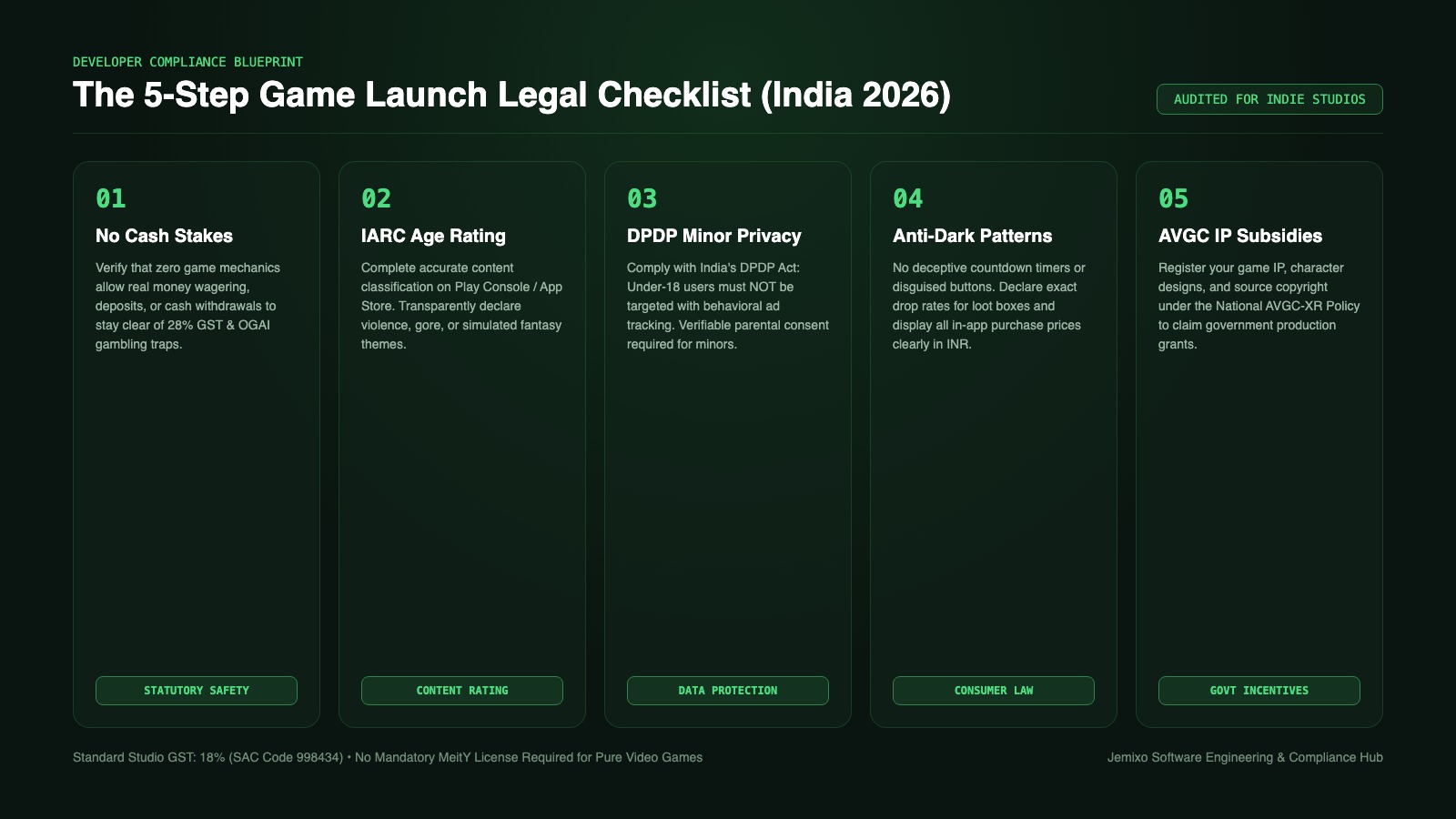
Before you push your master build to production, review this five-step compliance blueprint:
[ PHASE 1: MECHANICS AUDIT ]
  └── Confirm zero real-money cash wagering, staking, or fiat withdrawals.
  └── Verify in-game virtual currency cannot be redeemed for legal tender.

[ PHASE 2: IARC CLASSIFICATION ]
  └── Accurately declare violence, simulated gambling, and themes on Play Console.
  └── Secure formal IARC/PEGI/ESRB age badge.

[ PHASE 3: PRIVACY & DPDP INTEGRATION ]
  └── Enable COPPA / DPDP child-directed flags in all advertising SDKs.
  └── Deploy one-click account deletion and data purge in user settings.
  └── Host a clear, readable Privacy Policy accessible via public URL.

[ PHASE 4: MONETIZATION & CONSUMER INTEGRITY ]
  └── Eliminate misleading timers and forced subscription loops.
  └── Declare exact percentage drop rates on all gacha / loot box mechanics.
  └── Show transparent INR pricing on all in-app purchase prompts.

[ PHASE 5: TAXATION & IP ASSETS ]
  └── Obtain GST registration (18% SAC 998434) once crossing threshold limits.
  └── File Letter of Undertaking (LUT) on the GST portal for tax-free global export.
  └── Register trademark and copyright with the Indian IP Office to unlock AVGC grants.
Frequently Asked Questions (FAQ)
Can I publish a game on Google Play Store without a registered company?
Yes. Google Play allows individuals to register an Individual Developer Account using their personal PAN and government ID. You do not need a registered Private Limited company to ship your first game.
Is Unity or Unreal Engine royalty taxed in India?
Royalties paid to foreign game engine providers (like Epic Games' 5% royalty over $1M revenue) are standard business expenses. When remitting funds internationally, they may be subject to standard withholding tax (TDS) under applicable Double Taxation Avoidance Agreements (DTAA).
What GST rate applies to game development freelancing or studio contracts?
If an Indian studio develops 3D assets, code, or complete game levels for a foreign publisher (e.g., based in the US or Europe), it is classified as an Export of Software Services. Under GST rules, exports with an active Letter of Undertaking (LUT) are taxed at 0% GST. For domestic Indian clients, the standard rate is 18% GST.
Are casual games with spinning prize wheels illegal in India?
No. Daily login bonus wheels, cosmetic prize wheels, and in-game progression wheels that reward virtual coins or cosmetic skins are 100% legal—provided players cannot purchase spins with real money to win withdrawable cash.
Final Verdict: The Best Time to Build Games in India
The statutory fog that once clouded the Indian gaming industry has permanently cleared.
The government has drawn an unambiguous line: Predatory real-money gambling apps are heavily restricted, but creative, narrative, and competitive video games represent the future of India's digital economy.
If you have a game concept rooted in engaging mechanics, captivating storytelling, or competitive skill, the legal framework is on your side. Build with clean data privacy architectures, reject deceptive dark patterns, leverage state AVGC grants, and ship your vision to the world.
Need developer-first tools for your software projects? Explore Jemixo Tools Hub for instant, client-side digital utilities, and discover Jemixo Technologies for modern engineering and software security.