Between 2023 and 2024, the global information technology landscape was swept by an intoxicating wave of generative AI hype. Every tech conference echoed the same buzzwords: "chatbots," "prompt engineering," "copilots," and "wrapper APIs."
Fast forward to 2026, and the honeymoon phase has permanently closed.
Enterprise CTOs, software architects, and engineering leads across Bengaluru, Silicon Valley, London, and Singapore are confronting the cold economic realities of the initial AI rush:
- Runaway Cloud Invoices: Sending millions of basic user requests to proprietary frontier models resulted in catastrophic API billing spikes.
- Data Sovereignty & Privacy Frictions: Regulatory frameworks like India's DPDP Act, Europe's AI Act, and US state privacy mandates strictly penalize uploading confidential customer records or codebases to multi-tenant third-party clouds.
- The Limits of Chat: Developers realized that asking an LLM for copy-pasted code snippets creates immense technical debt unless integrated into automated, self-verifying architectural loops.
In 2026, the IT sector has matured from flashy parlor tricks to resilient, autonomous, and cost-efficient distributed systems.
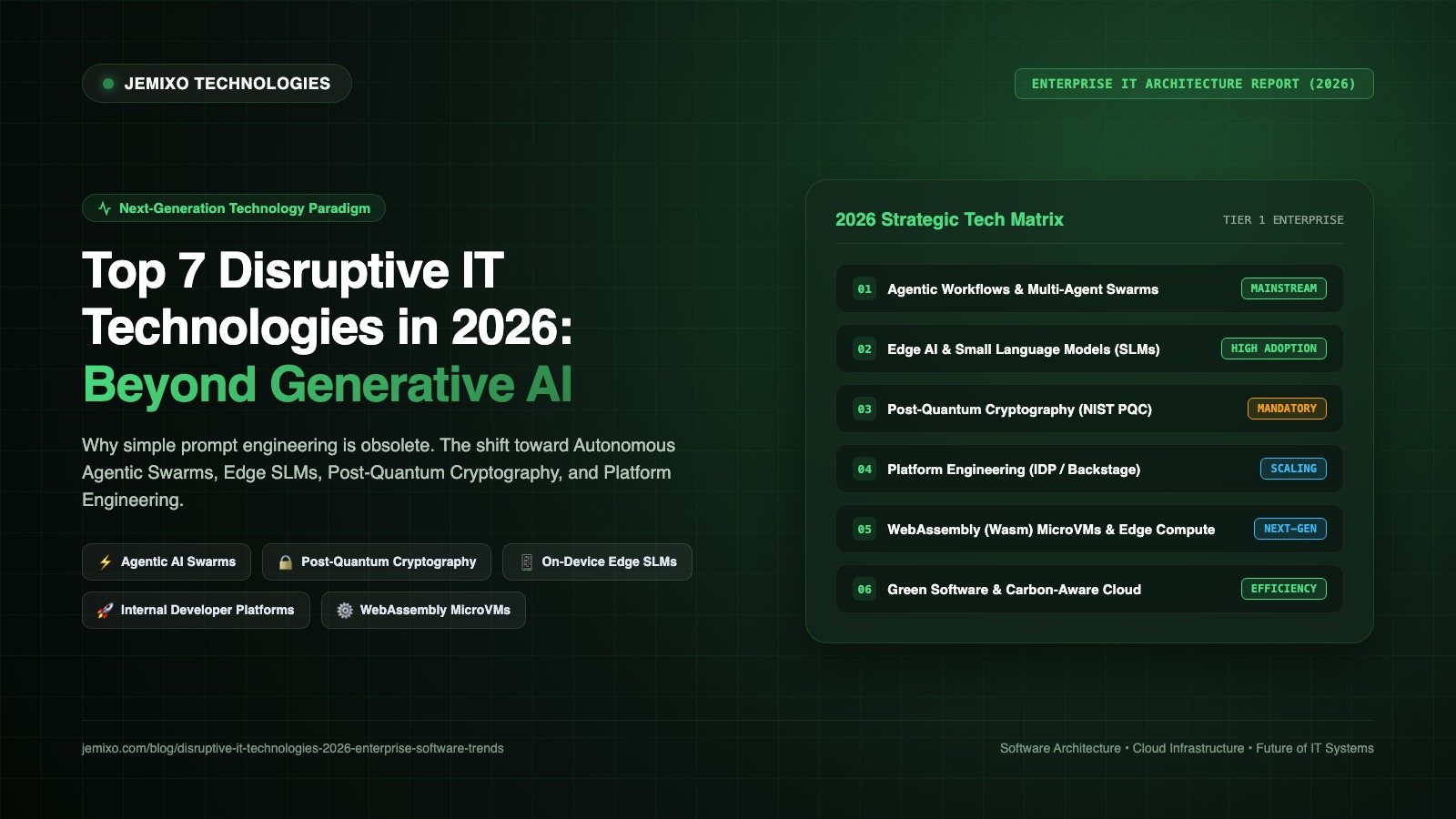
If you are a software engineer, technical architect, or engineering leader planning your technology roadmap for the next 3 to 5 years, here are the Top 7 Disruptive IT Technologies defining production systems today—and why they matter far more than basic generative AI prompts.
1. Autonomous Agentic Workflows & Multi-Agent Swarms
In 2024, AI operated like a glorified autocomplete: you typed a prompt, and the model returned a linear completion.
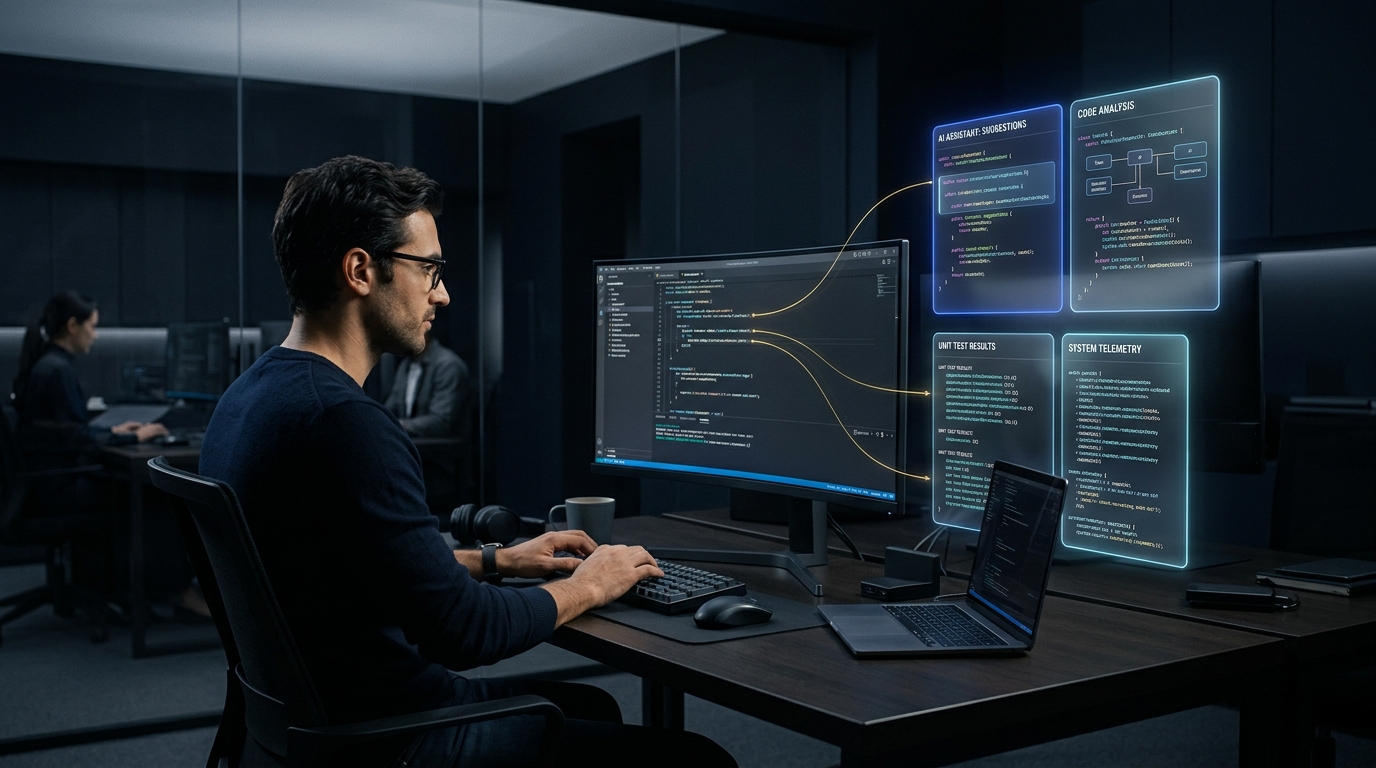
In 2026, software development and IT operations are driven by Agentic Workflows—architectures where autonomous AI agents plan, execute, critique, iterate, and use tools independently to accomplish multi-step objectives.
┌────────────────────────────────────────────────────────────────────────┐
│             TRADITIONAL LLM CALL VS 2026 AGENTIC SWARM                 │
├───────────────────────────────────┬────────────────────────────────────┤
│ 2024: Linear Single-Shot          │ 2026: Multi-Agent Collaboration    │
├───────────────────────────────────┼────────────────────────────────────┤
│ User: "Write a login endpoint"    │ 1. Architect Agent plans schema    │
│ LLM: Returns untested JS snippet  │ 2. Coder Agent writes Rust/Go API  │
│ Result: Dev copies, debugs errors │ 3. Security Agent checks JWT & SQLi│
│                                   │ 4. QA Agent writes & executes tests│
│                                   │ 5. Reviewer Agent merges PR        │
└───────────────────────────────────┴────────────────────────────────────┘
The Production Breakthrough:
Frameworks like LangGraph, CrewAI, and Anthropic's Model Context Protocol (MCP) have made multi-agent collaboration standard in enterprise CI/CD.
Instead of engineers triaging Jira bug tickets manually, specialized agent swarms reproduce bugs in sandboxed Docker containers, pinpoint the git commit causing the regression, draft an architectural patch, verify that all existing unit tests pass, and present a fully documented Pull Request for human sign-off.
2. Edge AI & Small Language Models (SLMs)
The era of routing every trivial microservice request to massive 500-billion-parameter cloud models is officially over.
In 2026, the most cost-effective and secure software architectures run on Small Language Models (SLMs)—highly optimized models ranging between 1 billion and 8 billion parameters (such as Microsoft's Phi-4, Meta's Llama 3.3 8B, and Google's Gemma 2) deployed directly on edge servers, developer laptops, and mobile hardware.
Why Enterprises Are Migrating to Edge SLMs:
- Zero Recurring API Costs: Once quantized (using GGUF or INT4/FP8 formats), an 8B model runs efficiently on local workstation GPUs or Apple Silicon Neural Engines at zero marginal token cost.
- Sub-10 Millisecond Latency: No HTTP roundtrips across global datacenters. Edge models respond instantly for real-time code completion, document extraction, and biometric inspection.
- Ironclad Data Sovereignty: Confidential intellectual property, source code, medical histories, and banking records never cross the boundary of your company firewall or phone memory.
[!TIP] Architectural Rule for 2026: Build your baseline applications around local SLMs via runtimes like Ollama or ONNX Runtime, and route to expensive frontier cloud models only when deep synthetic reasoning is strictly required.
3. Post-Quantum Cryptography (PQC): The NIST Standard Revolution
While quantum computers capable of breaking RSA and ECC encryption are still emerging, the cybersecurity threat is already actively unfolding today.
Under the "Harvest Now, Decrypt Later" (HNDL) strategy, nation-state adversaries and sophisticated cyber syndicates are intercepting and archiving petabytes of encrypted enterprise traffic today, intending to decrypt it once cryptanalytically relevant quantum computers (CRQCs) come online.
In late 2024 and through 2026, the US National Institute of Standards and Technology (NIST) officially released the world's first post-quantum encryption standards:
- FIPS 203 (ML-KEM): Module-Lattice-Based Key-Encapsulation Mechanism (primary standard for securing general web traffic and TLS handshakes).
- FIPS 204 (ML-DSA): Module-Lattice-Based Digital Signature Algorithm (for authenticating software binaries and digital documents).
- FIPS 205 (SLH-DSA): Stateless Hash-Based Digital Signature Algorithm.
What IT Teams Must Do Now:
Leading cloud providers (AWS, Cloudflare, Google Cloud) have already rolled out hybrid PQC-enabled TLS 1.3 ciphers. Enterprise software teams in banking, healthcare, and SaaS must audit their public key infrastructure (PKI), database encryption keys, and JWT signature engines to transition away from classical RSA-2048 and Elliptic Curve Diffie-Hellman (ECDH).
4. Platform Engineering vs Traditional DevOps Sprawl
For the past decade, the tech industry preached: "You build it, you run it."
In practice, this transformed developers into exhausted pseudo-sysadmins who spent 40% of their working hours wrestling with complicated Kubernetes Helm charts, cryptic Terraform scripts, AWS IAM permissions, and broken CI/CD pipelines.
In 2026, the industry has universally embraced Platform Engineering:
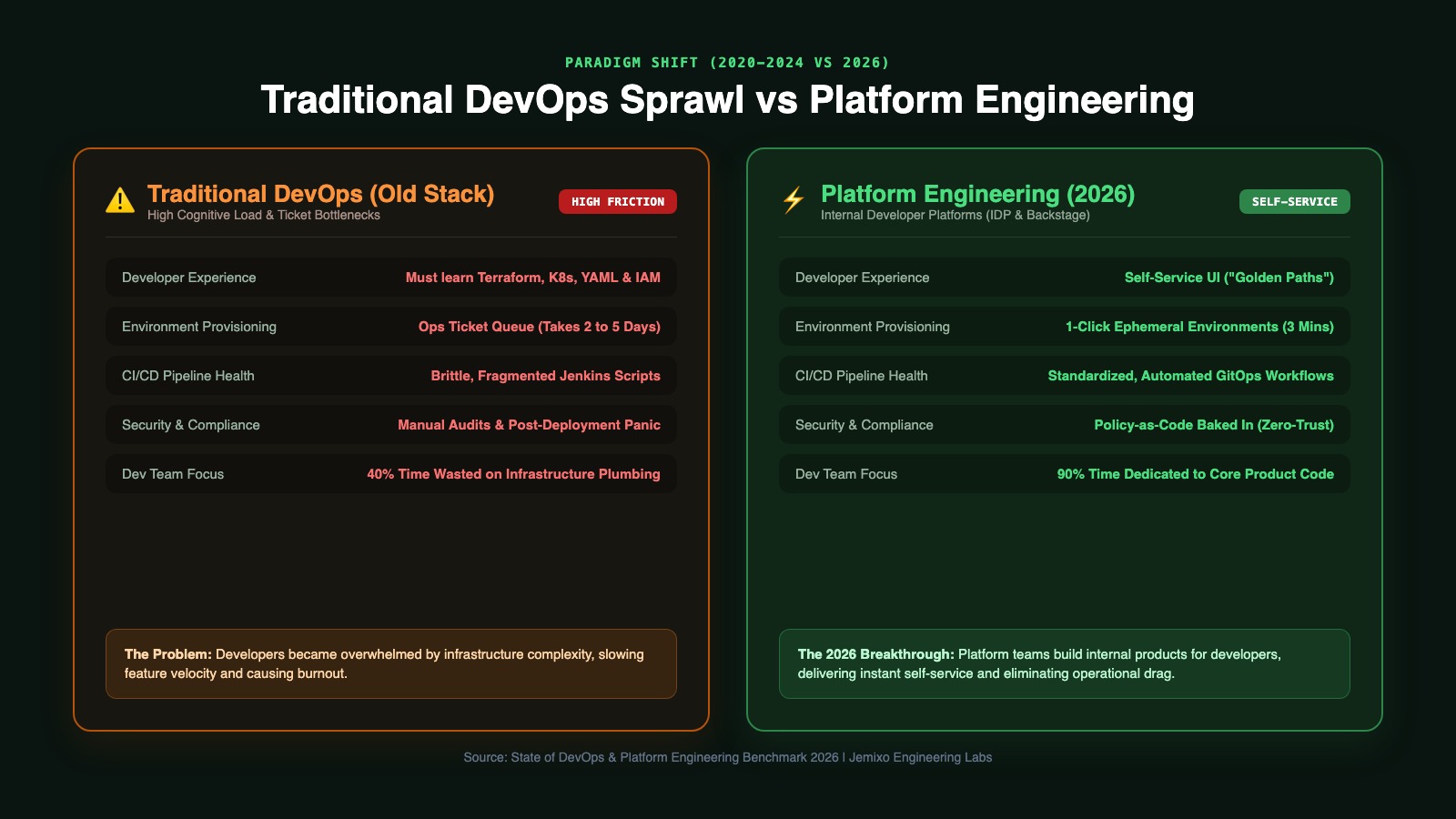
The Core Difference:
Instead of asking every product developer to become an infrastructure specialist, organizations form dedicated Platform Teams who treat infrastructure as an internal product.
Using frameworks like Spotify's Backstage, Port, and Crossplane, platform teams deliver an Internal Developer Platform (IDP) that provides "Golden Paths":
- A developer clicks one button to scaffold a new production-ready microservice with pre-configured observability, zero-trust security policies, automated CI/CD, and database connections.
- Ephemeral staging environments are spawned in 90 seconds and automatically destroyed when PRs close.
- Cognitive load drops dramatically, freeing product engineers to focus 95% of their mental energy on core business logic.
5. WebAssembly (Wasm) MicroVMs & Next-Gen Serverless
Docker revolutionized enterprise software over the last decade, but containers carry significant architectural weight: they package an entire guest operating system filesystem, take hundreds of milliseconds (or seconds) to boot up, and consume substantial memory overhead.
In 2026, WebAssembly (Wasm) has escaped the web browser to become the de-facto compute layer for high-density, serverless cloud workloads and edge computing.
Why Wasm MicroVMs Outperform Traditional Containers:
- Sub-Millisecond Cold Starts: A Wasm module starts up in less than 1 millisecond (compared to 1,000–3,000ms for a cold Docker container).
- Near-Zero Memory Footprint: While a minimal container takes 50MB to 200MB of RAM, a compiled Wasm binary operates in single-digit megabytes or kilobytes.
- True Capability-Based Security: Wasm bytecode executes inside a cryptographically secure sandbox governed by the WebAssembly System Interface (WASI 0.2). By default, the code cannot touch the filesystem, open network sockets, or access system clocks unless explicitly granted capability tokens.
Companies like Cloudflare Workers, Fastly Compute, and Spin (Fermyon) are running millions of isolated tenant functions per server node, reducing cloud compute bills by over 60%.
6. Green Software Engineering & Carbon-Aware Cloud Computing
Until recently, software engineers rarely considered the electrical grid impact of their code. However, the astronomical energy consumption of massive AI training clusters and high-density GPU datacenters has turned energy efficiency into an urgent financial and environmental KPI.
Under modern corporate ESG mandates and energy tariffs, enterprise software in 2026 is built on Green Software Principles:
- Carbon-Aware Workload Scheduling:
Cloud background jobs, model fine-tuning, and massive batch ETL pipelines are dynamically shifted across global cloud regions to run during hours when local solar and wind power generation is peaking. - Systems-Level Language Resurgence (Rust & Go):
Memory-heavy interpreted runtimes are systematically replaced by compiled, zero-cost-abstraction languages like Rust and Go. A microservice rewritten in Rust uses up to 80% less memory and 70% less CPU energy compared to equivalent Python or legacy Java stacks. - Data Transfer Minimization:
Employing binary serialization formats (Protocol Buffers, FlatBuffers, Apache Arrow) instead of bloated JSON payloads over HTTP to slash network bandwidth and transmission power.
7. Synthetic Data Engines & Zero-Copy Architectures
With strict global privacy enforcement (India's DPDP Act, GDPR, CCPA) and the reality that the public internet has largely run out of high-quality human text and image data, enterprise tech companies cannot simply scrape real user records to train or benchmark their systems.
In 2026, Synthetic Data Generation has emerged as a multi-billion-dollar enterprise vertical:
- Mathematical Privacy Guarantees: Synthetic data engines generate millions of artificial customer profiles, banking transactions, and sensor logs that mirror the exact statistical distributions and edge cases of real datasets—without containing a single real person's PII.
- Zero-Copy Data Pipelines: Instead of duplicating terabytes of data across multiple analytical lakes, modern architectures use zero-copy formats like Apache Iceberg and DuckDB, querying data in-place without expensive network serialization.
📊 The 2026 Enterprise IT Technology Radar
To help software engineering teams prioritize their technical roadmap, here is how leading architectural teams categorize these technologies today:
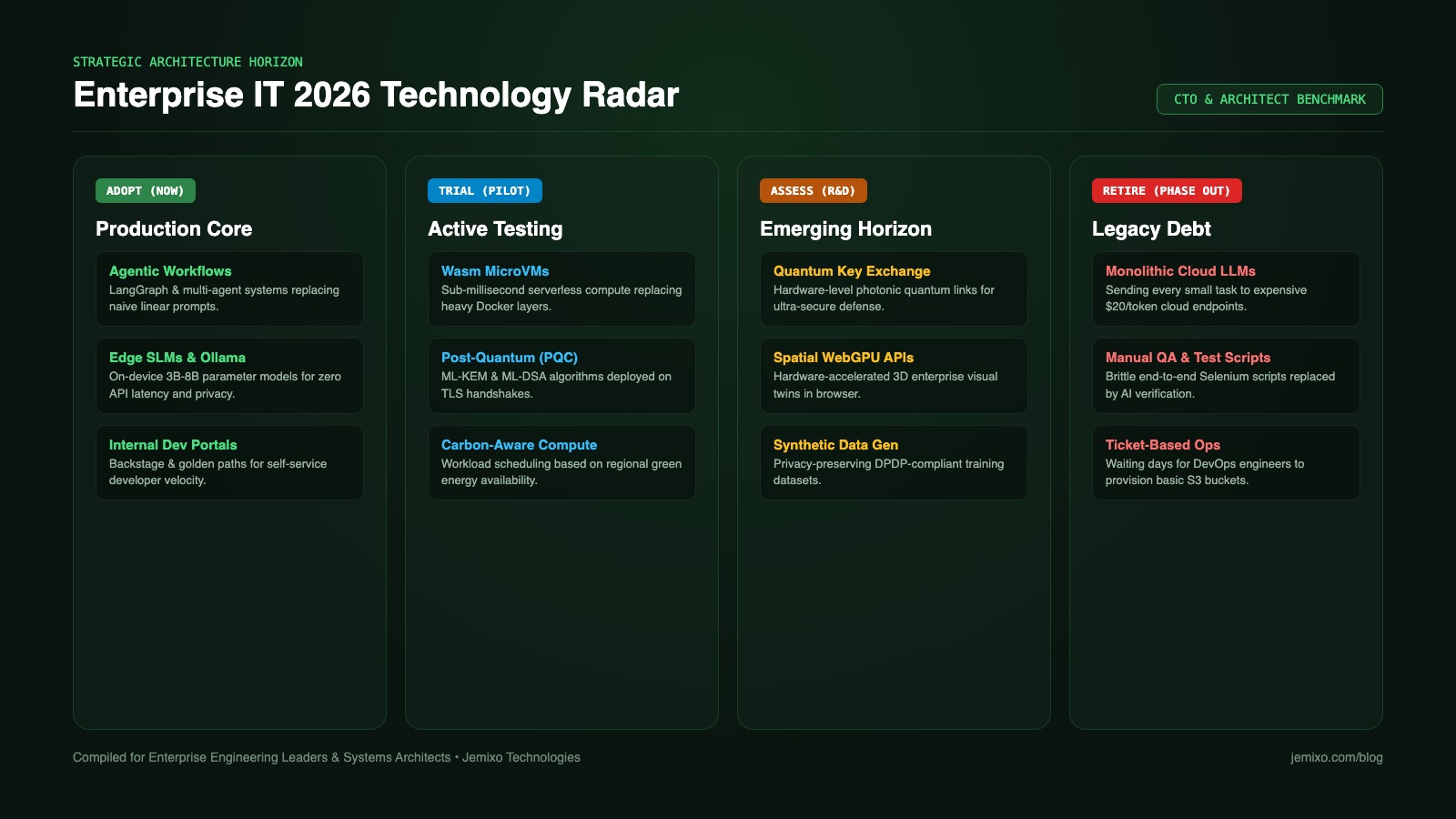
┌─────────────────┬──────────────────────────────────────────────────────┐
│ RADAR RING      │ TECHNOLOGIES TO IMPLEMENT IN 2026                    │
├─────────────────┼──────────────────────────────────────────────────────┤
│ 🟢 ADOPT (Now)  │ • Multi-Agent Workflows & LangGraph Orchestration    │
│                 │ • Edge SLMs & On-Device Inferencing (Ollama, ONNX)   │
│                 │ • Platform Engineering & Internal Dev Portals (IDPs) │
├─────────────────┼──────────────────────────────────────────────────────┤
│ 🔵 TRIAL        │ • WebAssembly (Wasm) MicroVMs for Serverless Compute │
│                 │ • Hybrid Post-Quantum TLS 1.3 (NIST ML-KEM)          │
│                 │ • Carbon-Aware Background Job Scheduling             │
├─────────────────┼──────────────────────────────────────────────────────┤
│ 🟡 ASSESS       │ • Quantum Key Distribution (QKD) Hardware Links      │
│                 │ • WebGPU-Accelerated Enterprise Spatial Interfaces   │
│                 │ • Synthetic Data Privacy-Preserving Generators       │
├─────────────────┼──────────────────────────────────────────────────────┤
│ 🔴 RETIRE       │ • Sending Private User PII to Multi-Tenant Cloud LLMs│
│                 │ • Ticket-Based Manual DevOps & Terraform Sprawl      │
│                 │ • Brittle, Slow End-to-End Selenium Test Suites      │
└─────────────────┴──────────────────────────────────────────────────────┘
Frequently Asked Questions (FAQ)
Will Autonomous AI Agents replace human software engineers in 2026?
No. AI agents excel at synthesizing boilerplate code, diagnosing regression bugs, and generating test fixtures. However, human engineers remain indispensable for high-level systems design, business context alignment, ethical security auditing, and critical domain judgment. The role of the engineer has evolved from a "code typist" to an "architectural supervisor."
What is the primary difference between DevOps and Platform Engineering?
DevOps is a cultural philosophy emphasizing shared responsibility between development and operations. However, DevOps often burdened developers with overwhelming infrastructure chores. Platform Engineering solves this by creating dedicated platform teams who treat infrastructure as an internal product, delivering intuitive self-service portals (IDPs) that shield developers from low-level cloud complexity.
How can a mid-sized IT company prepare for Post-Quantum Cryptography?
Start with a cryptographic inventory: identify all certificates, key exchange algorithms, and data-at-rest encryption ciphers across your microservices. Enable hybrid post-quantum cipher suites (like X25519Kyber768 / ML-KEM) supported natively in modern web servers (Nginx, Cloudflare, AWS ALB), and ensure external dependencies are updated to support NIST FIPS 203 standards.
Are Small Language Models (SLMs) accurate enough for production enterprise work?
Yes. When fine-tuned on clean domain-specific data or augmented with targeted Retrieval-Augmented Generation (RAG), 3B to 8B parameter models achieve equal or superior accuracy on specialized tasks (such as code linting, JSON schema extraction, and classification) compared to multi-hundred-billion-parameter general cloud LLMs—at a fraction of the latency and operational cost.
Conclusion: Engineering the Resilient Enterprise
The defining characteristic of successful IT organizations in 2026 is not how many AI prompts their employees run, but how resilient, efficient, and sovereign their underlying software systems are built.
By adopting agentic multi-agent orchestration, moving privacy-critical inference to edge SLMs, insulating networks with post-quantum cryptography, and liberating developers through platform engineering, engineering teams can build software that scales reliably through the next decade of digital evolution.
Looking to modernize your enterprise software architecture or deploy high-performance, privacy-first digital platforms? Discover how Jemixo Technologies builds world-class custom applications, cloud architectures, and developer tools for the modern digital era.