In 2023 and 2024, every software boardroom was gripped by a single mandate: "Connect our product to OpenAI or Anthropic via API, immediately." Fast-forward to 2026, and the honeymoon period is decisively over. Engineering leaders and CTOs across the globe are waking up to an uncomfortable reality—cloud-hosted Large Language Models (LLMs) come with crippling marginal token costs, unpredictable 1,500ms latency spikes, and severe data privacy vulnerabilities under strict regulations like India's Digital Personal Data Protection (DPDP) Act and the EU AI Act.
The counter-revolution has arrived, and it is powered by Small Language Models (SLMs) running directly on edge hardware. From Meta's Llama 3.2 (1B & 3B) and Microsoft's Phi-3.5 / Phi-4 series to Google's Gemma 2 (2B & 9B), modern compact models have closed the intelligence gap for domain-specific business workloads. By running quantized open-weights models directly on client hardware (smartphones, browsers, POS terminals, and local edge servers), engineering teams are achieving sub-30ms inference speeds, zero recurring API expenses, and bulletproof offline privacy.

1. The 2026 AI Hangover: Why Cloud-Only LLMs Break at Scale
When you build a prototype or an internal demo with 100 daily queries, paying $0.03 per thousand tokens feels like pocket change. But when your enterprise SaaS scales to 50,000 active daily users processing document parsing, chat assistance, data classification, and automated workflows, the cloud LLM architecture reveals three fundamental bottlenecks:
A. The Uncapped Marginal Cost Trap
Traditional software scales with near-zero marginal cost—serving the 100,000th HTTP request costs virtually the same as the 1,000th. Cloud LLMs inverted this economic principle. Every single user interaction triggers forward passes through gigantic multi-billion-parameter clusters hosted on expensive H100/B200 GPU infrastructure. At enterprise scale, token invoices can easily reach $25,000 to $80,000 per month—eroding software gross margins from healthy 80% SaaS benchmarks down to single digits.
B. The Roundtrip Latency Penalty
Even with optimized streaming endpoints, cloud LLMs are bound by network physics:
- DNS resolution & TLS handshake: 40ms – 120ms
- Payload transit over cellular/Wi-Fi: 80ms – 250ms
- Cloud GPU queue scheduling & Time-To-First-Token (TTFT): 400ms – 1,200ms
- Full generation & token streaming: 800ms – 2,500ms
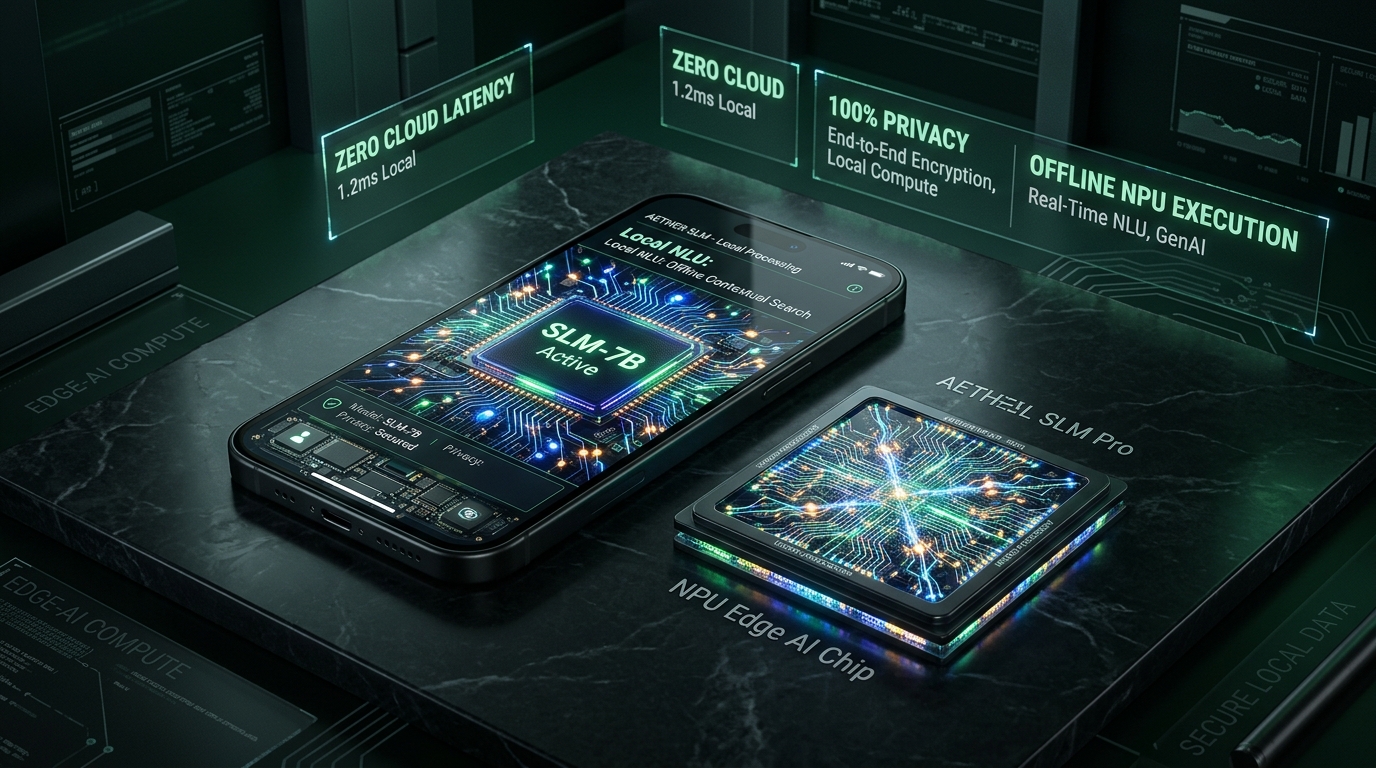
For interactive interfaces, on-device autocomplete, instant search, and real-time UI assistance, a 2-second lag completely ruins user retention. By contrast, an on-device SLM executing on a smartphone's Neural Processing Unit (NPU) delivers first tokens in 12ms to 25ms.
C. Compliance, DPDP Act & Data Sovereignty
Under India's DPDP Act 2023, GDPR, and sector-specific banking (RBI) regulations, transmitting Personally Identifiable Information (PII), medical transcripts, or financial statements across third-party cloud LLM APIs turns your business into a high-liability data fiduciary. Even with contractual "zero data retention" agreements, legal teams increasingly demand architectural guarantee of data confinement—ensuring sensitive bits physically never leave the user's local silicon.
2. Cloud LLMs vs. Edge SLMs: 2026 Architecture Comparison
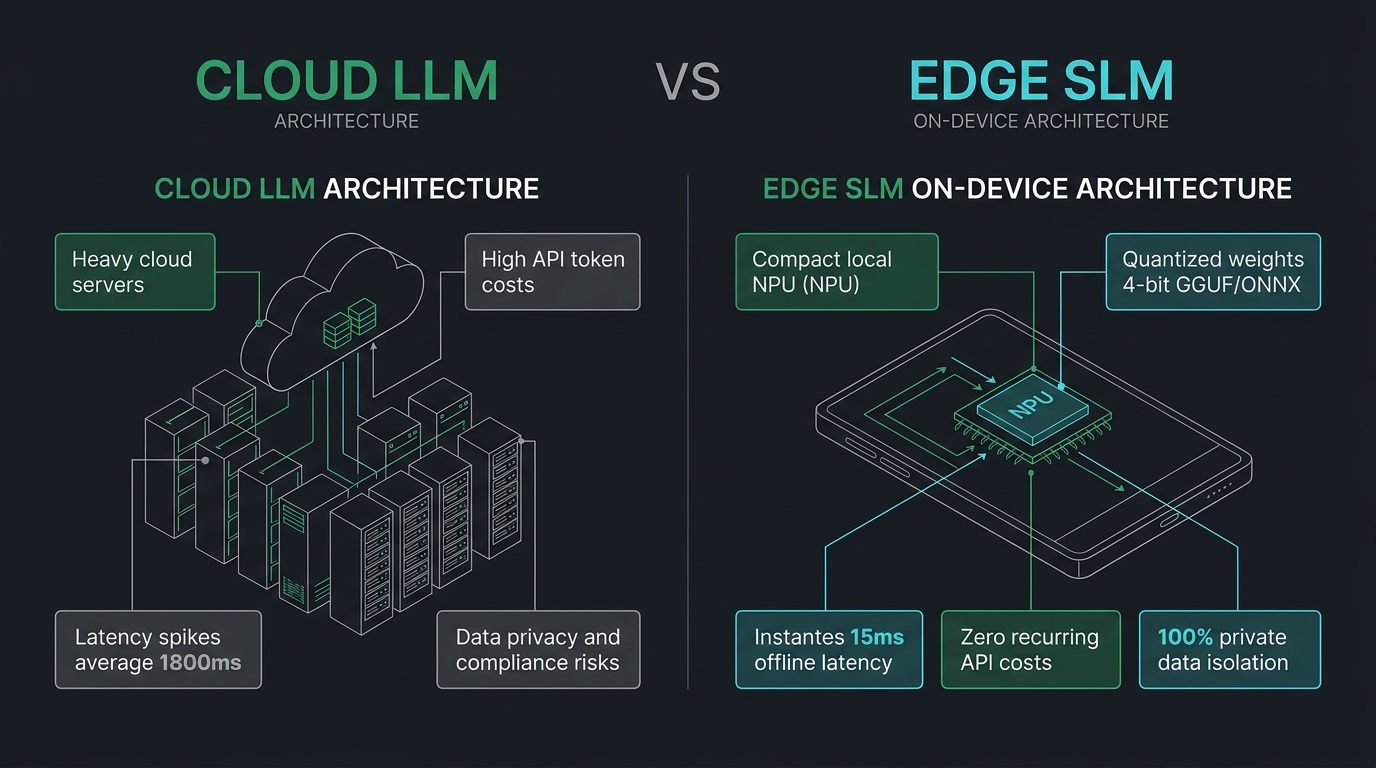
To understand why engineering studios are re-architecting their tech stacks, look at how the two paradigms compare across core operational metrics:
| Performance Dimension | Cloud LLM (GPT-4o, Claude 3.5, Gemini 1.5) | On-Device Edge SLM (Llama 3.2 3B, Phi-3.5, Gemma 2 2B) |
|---|---|---|
| Time-to-First-Token (TTFT) | 600ms – 1,800ms (High variance) | 15ms – 40ms (Instantaneous local NPU) |
| Cost per 1M Inferences | $2,500 – $15,000 (Recurring monthly token fees) | $0.00 (Runs on consumer's own device compute) |
| Network Dependency | 100% Online connection mandatory | 100% Offline / Air-Gapped Capable |
| Data Privacy & Liability | Third-party cloud exposure, regulatory audits | Zero Data Leaves Device (Architectural compliance) |
| Hardware Footprint | Requires 80GB VRAM enterprise server GPUs | 1.1GB – 2.8GB RAM (4-bit quantized GGUF/ONNX) |
| Downtime & Outage Risk | Vulnerable to third-party API outages & rate limits | Zero Downtime (Self-contained in app binary/assets) |
3. What Made SLMs Capable in 2026? The Technical Breakthroughs
Two years ago, attempting to run an open-source model on a smartphone produced gibberish or overheated the battery in seconds. What changed?
1. High-Density Synthetic Training (Quality Over Quantity)
Pioneered by Microsoft's "Textbooks Are All You Need" research and perfected across 2025–2026, modern SLMs are trained on mathematically curated, synthetic, high-purity educational datasets rather than messy web scrapes. A 3-billion-parameter model trained on pristine, multi-step synthetic reasoning curricula routinely outperforms 2023-era 70-billion-parameter models on domain tasks like entity extraction, SQL query generation, grammar correction, and intent routing.
2. Post-Training Quantization (4-Bit & 3-Bit AWQ / GGUF)
Original models store weights in 16-bit floating-point (FP16), requiring 2 bytes per parameter (a 3B model needs ~6GB RAM). Modern quantization techniques—such as Activation-aware Weight Quantization (AWQ) and GGUF k-quants—compress weights down to 4 bits or even 3.5 bits per parameter with less than 0.8% drop in task perplexity. That shrinks a high-reasoning 3B model down to 1.6GB, comfortably fitting into standard 6GB/8GB smartphone RAM without killing background apps.
3. Dedicated Mobile Silicon (NPUs on Every Chipset)
In 2026, dedicated hardware acceleration is standard across all tiers:
- Apple Silicon (A18 / M4): 16-core Neural Engine achieving over 38 TOPS (Trillion Operations Per Second).
- Qualcomm Snapdragon 8 Elite / 7 Gen series: Hexagon NPU capable of generating over 20 tokens per second locally.
- MediaTek Dimensity 9400 / 8300: Generative AI Engine with on-device hardware decompression.
4. The Modern On-Device AI Engineering Pipeline
Building production applications powered by on-device SLMs requires a disciplined engineering workflow distinct from traditional cloud API wrappers:
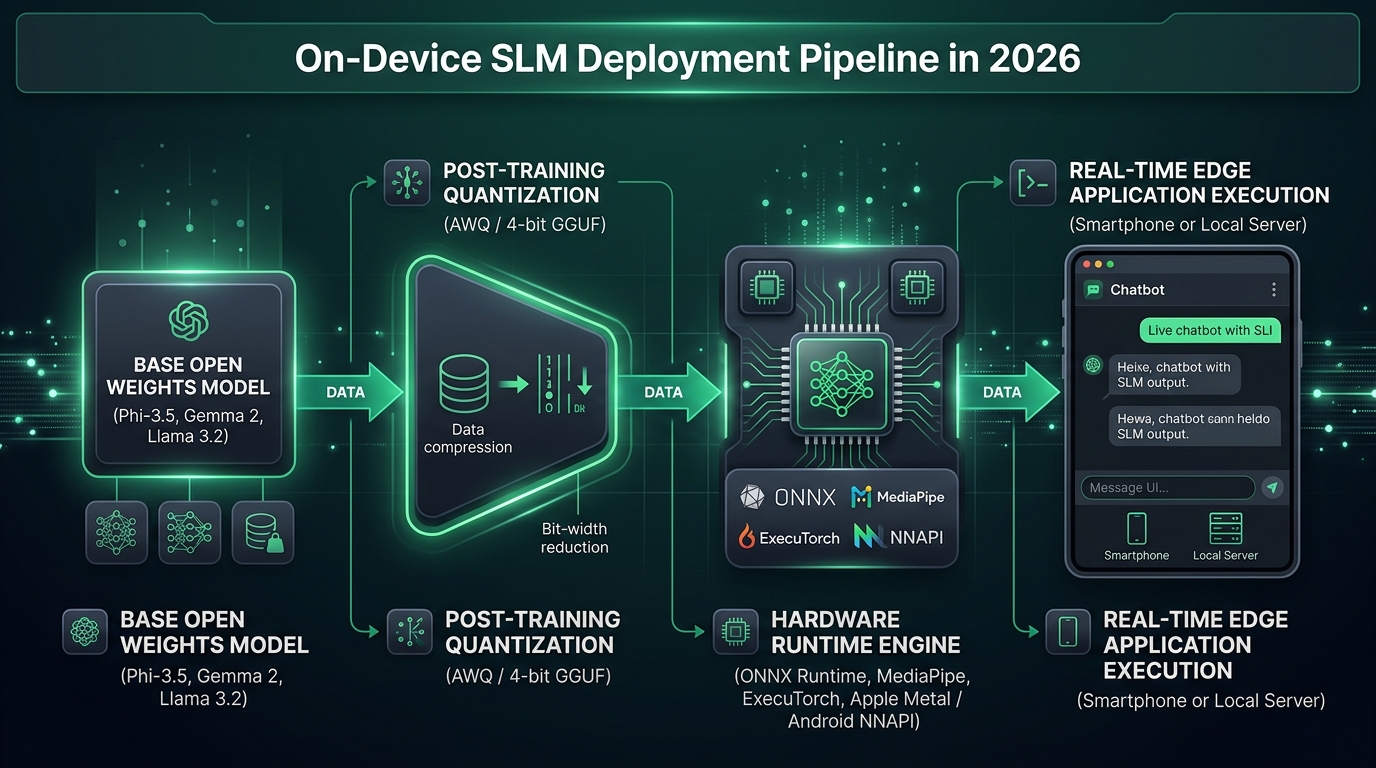
Step 1: Domain-Specific Fine-Tuning (LoRA / QLoRA)
Rather than expecting an SLM to know everything about world history, engineering teams freeze the base weights and train lightweight Low-Rank Adaptation (LoRA) adapters on specific operational datasets (e.g., medical triage syntax, GST invoice extraction schemas, or cybersecurity APK threat signatures). The resulting adapter is often less than 40MB in size.
Step 2: Quantization & Serialization
The merged model is compiled using ONNX Runtime GenAI, ExecuTorch, or llama.cpp quantization engines into target runtime formats (.onnx, .pte, or .gguf), mapping matrix operations directly to 8-bit integer (INT8) or 4-bit integer (INT4) arithmetic.
Step 3: Hardware Runtime Binding
The application links against native hardware execution providers:
- iOS / macOS: CoreML / Metal Performance Shaders (MPS)
- Android: Android NNAPI, Qualcomm QNN, MediaTek NeuroPilot, or Google MediaPipe GenAI Tasks
- Cross-Platform Desktop & Web: WebGPU through ONNX Runtime Web (executing directly in Chrome/Brave with zero installation)
Step 4: Smart Local Cache & Context Window Management
Mobile RAM is precious. Production edge architectures use sliding-window attention (SWA) and quantized KV-cache (Key-Value cache in 8-bit) to ensure memory consumption stays rock-solid below 250MB during long multi-turn interactions.
5. How Jemixo Technologies Implements Edge AI in Production
At Jemixo Technologies, on-device AI is not a speculative roadmap item—it is the foundational engineering principle powering our flagship products:
🛡️ Jemixo Safe — 100% On-Device Cyber Scam Radar
Built for Bharat's mobile users, Jemixo Safe analyzes incoming SMS phishing patterns, dangerous APK sideload signatures, and fraudulent call scripts entirely on the user's smartphone. By utilizing an embedded, ultra-compact on-device classification model, our app scans threats in under 8 milliseconds with 0 KB of user data uploaded to any cloud server.
📄 Jemixo Scanner & AI — Privacy-Preserving Document Intelligence
Scanning sensitive Aadhaar cards, tax invoices, and business contracts requires uncompromised discretion. Jemixo Scanner & AI runs edge-optimized optical character recognition (OCR) and an on-device document assistant. Users can ask questions, summarize multi-page agreements, and extract tabular ledger data offline on a flight without their confidential documents touching a remote server.
6. The Hybrid Edge-Cloud Pattern: The Pragmatic Architecture
Does the rise of SLMs mean cloud LLMs are dead? Absolutely not. Mature enterprise architectures in 2026 deploy a Hybrid Edge-Cloud Cascade:
- Tier 1 (Edge SLM - 85% of queries): Fast classification, form autofill, text normalization, threat scanning, PII redaction, and local search queries execute instantly on-device at $0 marginal cost.
- Tier 2 (Secure Cloud LLM - 15% of queries): Only when a task requires deep multi-step algorithmic code execution, 100,000-token historical synthesis, or creative design generation does the application scrub sensitive PII locally and securely dispatch a lightweight prompt to a heavy cloud frontier model.
This hybrid cascade cuts cloud API spending by 70% to 85% while simultaneously making the application feel 10x faster to end users.
Frequently Asked Questions (FAQ)
What is the difference between an LLM and an SLM?
Large Language Models (LLMs) typically have 70 billion to 1+ trillion parameters and require massive enterprise cloud GPU clusters to run. Small Language Models (SLMs) have 1 billion to 9 billion parameters, engineered with high-density synthetic data, allowing them to run locally on consumer devices like smartphones and laptops with low memory footprints and zero cloud API costs.
Can Small Language Models run completely offline?
Yes. Once quantized (using 4-bit GGUF or ONNX runtime formats) and packaged into an application binary or downloaded as an asset, SLMs execute locally on the device's CPU, GPU, or Neural Processing Unit (NPU) with zero internet connectivity required.
How much RAM is needed to run a 3B SLM on a smartphone?
A 3-billion-parameter model quantized to 4-bit precision (such as Llama 3.2 3B or Phi-3.5 Mini) typically requires between 1.6GB and 2.2GB of RAM. Modern mid-range and flagship smartphones with 6GB to 12GB of RAM can easily run these models without performance degradation.
How does on-device AI comply with India's DPDP Act 2023?
Under India's Digital Personal Data Protection (DPDP) Act, transmitting user data to third-party cloud servers triggers strict data fiduciary compliance, audit, and breach notification requirements. On-device SLMs keep all sensitive processing confined to the user's local hardware—meaning zero personal data is ever collected, stored, or transmitted over the network.
Conclusion: The Future of Software is Distributed and Private
The era of blind cloud dependency is closing. As hardware NPUs become ubiquitous and model compression techniques advance, software companies that continue relying exclusively on centralized cloud APIs will be undercut on price, latency, and regulatory compliance by teams embracing edge intelligence.
Whether you are building high-volume mobile applications, enterprise SaaS platforms, or specialized fintech solutions, embracing Small Language Models and on-device processing is the single most impactful architectural decision you can make in 2026.
🚀 Ready to Engineer On-Device AI for Your Product?
Jemixo Technologies engineers high-performance mobile applications, enterprise SaaS platforms, and privacy-first edge AI systems. Talk to our engineering team today to audit your architecture and build software that scales without runaway cloud bills.